

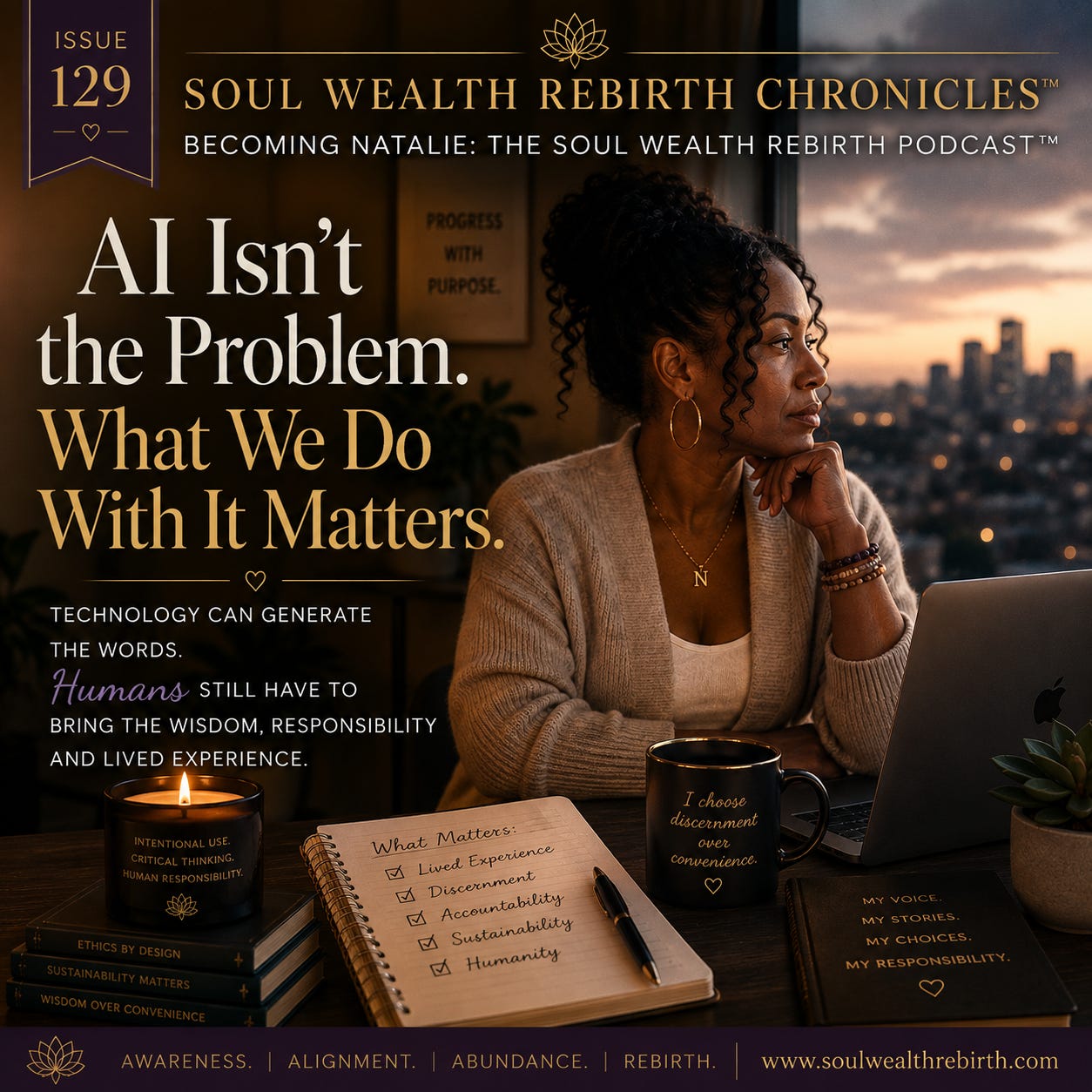
Technology can generate the words. Humans still have to bring the wisdom, responsibility and lived experience.
I didn’t expect a song to make me think this much about artificial intelligence.
But it did.
Back in Issue 122, I wrote about discovering that a song I deeply connected with had been created using AI.
Finding that out initially changed how I looked at it.
How could something that wasn’t born from someone’s lived experience speak so directly to mine?
Eventually, I realized something important.
The song didn’t give me my truth.
I recognized myself in it because I had already lived the truth it reflected.
That distinction stayed with me.
And recently, another conversation about AI made me revisit it from an entirely different direction.
This time, the conversation wasn’t about creativity.
It was about responsibility.
The conversation is bigger than whether AI is good or bad
I came across someone strongly criticizing the promotion of AI.
Part of the argument was that relying on AI could weaken people’s ability to think for themselves.
Another concern involved the environmental resources required to support rapidly expanding technology and the communities that may ultimately carry some of those costs.
And I found myself thinking:
There is something worth discussing here.
Not necessarily every conclusion.
Not necessarily every accusation.
But the questions?
Absolutely.
Because I use AI.
I also believe we should be asking what its expansion costs.
Those two beliefs can coexist.
I don’t believe responsible conversations require us to choose between being completely for something or completely against it.
Sometimes maturity requires us to hold the benefit and the consequence in the same conversation.
A tool should remain a tool
I think AI can be extraordinary.
It can help organize information.
It can help someone explore an idea.
It can challenge thinking.
It can assist with research, structure and creativity.
It can make certain resources more accessible.
But there is a line between using a tool to support your thinking and allowing a tool to do your thinking for you.
That distinction matters to me.
Because I don’t want technology to replace my curiosity.
I don’t want it to replace discernment.
And I certainly don’t want it to replace lived experience.
My stories have to remain mine.
My opinions have to remain mine.
My questions have to remain mine.
And ultimately, my decisions have to remain mine.
A tool can help me examine them.
It shouldn’t become the source of them.
The environmental question matters too
Innovation doesn’t get a free pass simply because it’s innovative.
If advancing technology requires significant amounts of energy, water, land or other resources, then asking whether those systems can be made substantially more efficient isn’t anti-technology.
It’s responsible innovation.
Progress that damages the environments and communities people need in order to live isn’t complete progress.
And as AI becomes more integrated into everyday life, I think those conversations deserve more attention, not less.
The goal shouldn’t simply be:
How powerful can we make this?
It should also be:
How responsibly can we build it?
Can the footprint become smaller?
Can the infrastructure become more sustainable?
Can communities have a meaningful voice in decisions that affect their resources?
Can technological progress and environmental stewardship advance together?
Those are not reasons to abandon innovation.
They’re reasons to improve it.
And then there is us
Technology will continue evolving.
But humans still determine how we engage with it.
We decide whether it becomes a shortcut or a collaborator.
We decide whether we question what it gives us.
We decide whether we preserve our own voices.
We decide whether convenience becomes dependency.
And we decide whether we demand better from the companies building the systems we increasingly rely upon.
That’s why I don’t think the most useful question is:
Is AI good or bad?
The better questions may be:
How are we using it?
What are we asking it to replace?
What are we unwilling to sacrifice for convenience?
And what responsibility comes with having access to something this powerful?
Issue 122 taught me that AI could generate something that reflected a truth I had already lived.
This chapter is teaching me something else.
The technology may be artificial.
Our responsibility isn’t.
And neither is our lived experience.
AI can help us create.
It can help us think.
It can help us see possibilities we hadn’t considered.
But I still believe the human being has to remain in the driver’s seat.
Thinking.
Questioning.
Feeling.
Choosing.
Living.
Because technology may become increasingly sophisticated.
But wisdom still requires us.
With grace,
Natalie
Soul Wealth Rebirth Chronicles™
Becoming Natalie: The Soul Wealth Rebirth Podcast™
www.soulwealthrebirth.com
© 2026 Soul Wealth Rebirth™. All rights reserved. Original writing from Soul Wealth Chronicles. Reproduction or redistribution without permission is prohibited.
Exactly! Don't get me started on this one. I'm going to force myself to be brief, but I've got to say something. If people stop being afraid of AI and pay attention to what they can do with it, perhaps they wouldn't be so quick to blame it for everything. Just like social media, it's what you do with it, how you use it is what you get from it. When you put trash prompts in, you're going to get trash results. What the real problem is what people are telling AI and feeding it without realizing the risk they're putting themselves or the company. Now I said I will keep it short, some I'm stopping myself here. Excellent article as usual.