

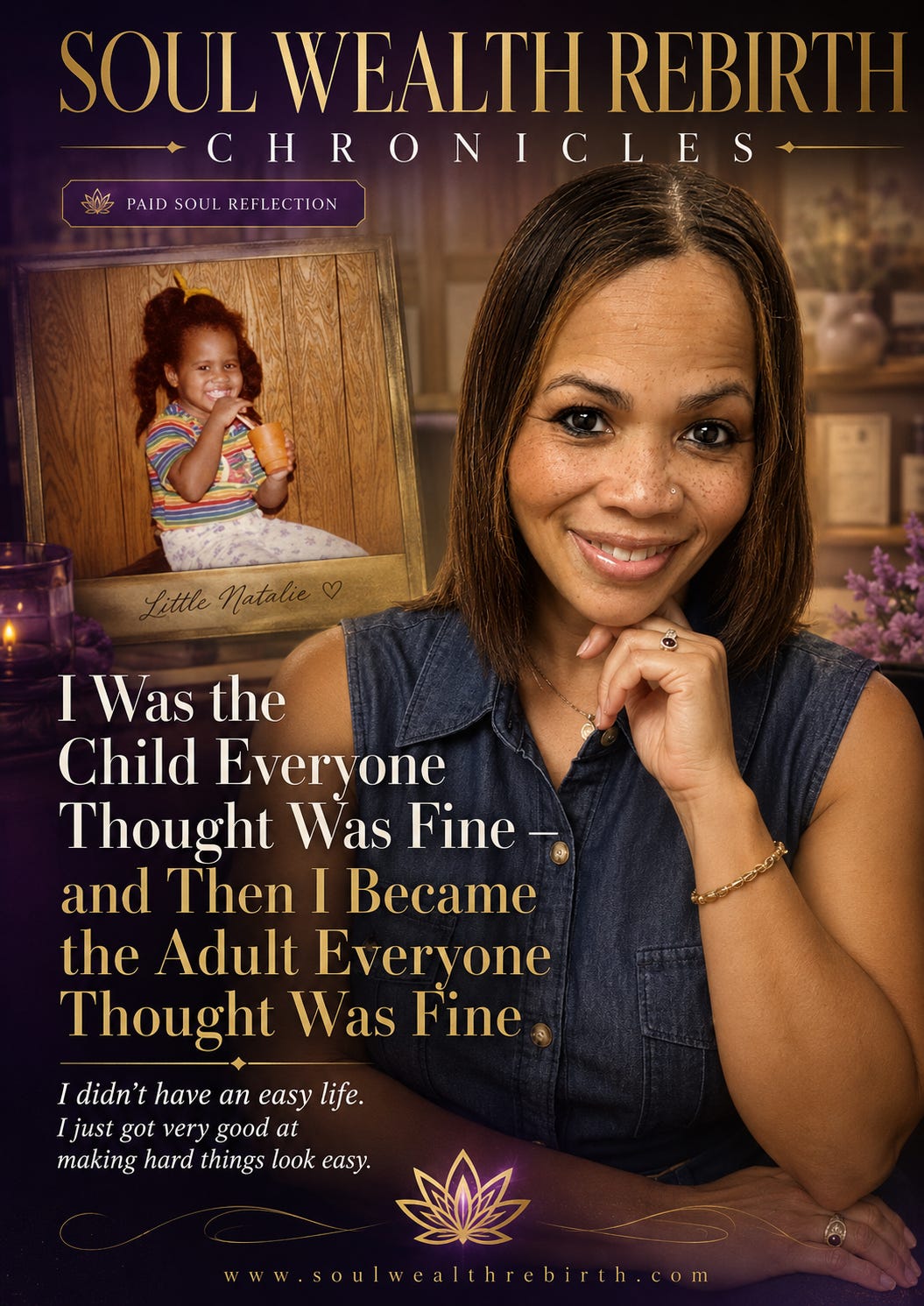
I didn’t have an easy life. I just got very good at making hard things look easy.
This week, I came across a TikTok that stopped me in my tracks.
The woman was talking about wanting a soft life
not because she was lazy, not because she expected life to stop challenging her, but because she had spent most of her life in survival mode.
She talked about reading rooms.
Watching facial expressions.
Listening for changes in someone’s voice.
Trying not to cause problems.
Keeping the peace.
Being strong because she had to be.
Being independent because depending on other people didn’t always feel safe.
And then she said something that landed so deeply that I almost felt like she had reached into my own life and put words around something I had never quite known how to explain:
Survival had become part of her personality.
Whew.
Because that was me.
Actually, that is me.
Or at least, it has been me for most of my life.
And at 50 years old, I am beginning to understand that some of the qualities I have always considered simply “who I am” may have started as adaptations I learned when I was a very little girl.
I Can Remember Being This Way at Five
Five is about as far back as I can clearly remember.
And even then, I remember being observant.
Independent.
Aware of other people.
I paid attention to moods.
Facial expressions.
Body language.
The feeling in a room.
I learned to adjust.
I learned to accommodate.
I learned not to become another problem someone had to solve.
I was the youngest of three girls, and there are seven years between each of us.
My two older sisters needed my parents in ways I apparently did not.
Or at least, that is how it looked.
I was independent.
I could entertain myself.
I could figure things out.
And somewhere along the way, I decided that I didn’t want to burden my parents when they already had other people who needed them.
So I became the child who was fine.
And my parents became comfortable believing me.
My Childhood Wasn’t Terrible
This part matters to me.
I don’t look back at my childhood and think that I had horrible parents.
I didn’t.
My parents loved us.
They took care of us.
They provided for us.
They were good role models in many ways.
They taught their daughters to be strong women.
And out of the three of us?
Apparently I took the assignment very seriously.
😂
I knew my parents loved me.
That was never really the question.
But affection and attention were different.
I don’t remember receiving as much of either as I probably needed.
Not because anyone sat down and decided that Natalie didn’t deserve them.
I think I simply became so good at appearing self-sufficient that it was easy to believe I didn’t need very much.
That’s the strange thing about independent children.
Sometimes adults become so proud of how little they need that nobody stops to ask whether they should have needed so little in the first place.
I Was Different Early Too
I never quite felt like I fit.
Not with my siblings.
Not with most of my extended family.
Not even socially.
I didn’t have a ton of friends.
I have always felt like something of a lone wolf.
A black sheep.
The person standing slightly outside the circle, observing everybody else.
And I became overweight when I was around six or seven years old.
I got teased.
I knew I was bigger.
But rather than allow anybody to think that my weight made me incapable, I overcompensated.
I wanted people to know:
I can still do it.
I can keep up.
I can participate.
I can accomplish things.
I can be successful.
I can handle myself.
Maybe that is where another layer of my lifelong pattern started.
I wasn’t just learning to survive.
I was learning to prove.
🔒 PAID SUBSCRIBER CONTINUATION
The rest of this Soul Reflection is for paid subscribers. I’m going deeper today into what happened when the “strong, independent child” became the woman everyone assumed had it together—and why I’m finally learning that needing help does not make me weak.
